
How Do Manufacturers Choose the Right Machines to Start a Disposable Hygiene Products Factory?
November 13, 2026
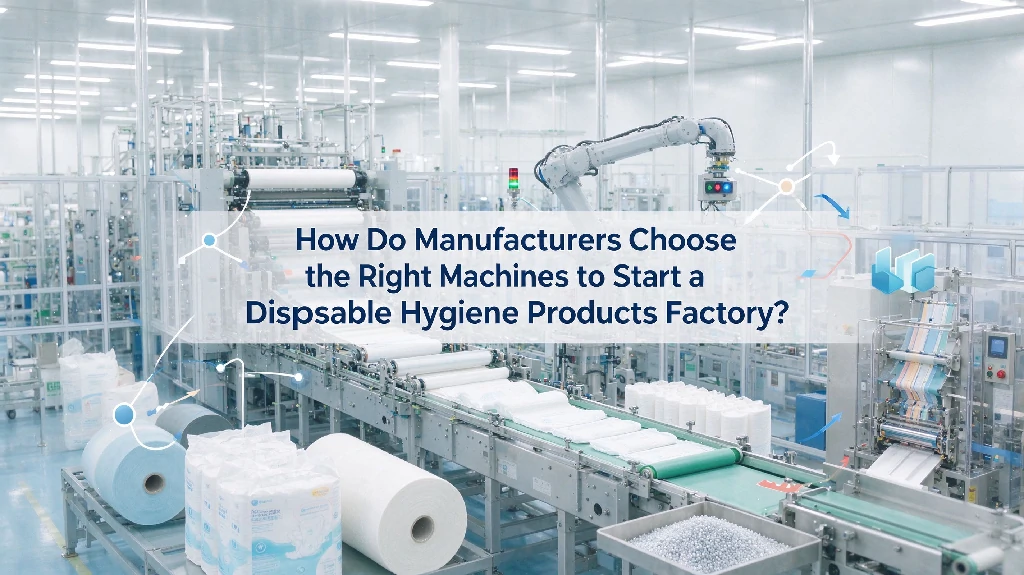
Manufacturers choose the right machines for a disposable hygiene products factory by matching production line automation levels, core-forming technologies, and auxiliary equipment to their target product mix, local labor costs, and daily output goals. Launching a new converting facility requires substantial capital allocation across primary converting lines, raw material handling units, and downstream packaging machinery. Factory directors must align machine specifications with regional consumer preferences before signing equipment procurement contracts. Selecting underpowered machinery creates immediate production bottlenecks, while over-investing in ultra-high-speed lines strains initial working capital. Operations teams evaluate machine footprints, utility requirements, and raw material tolerances to build a resilient manufacturing floor. This guide breaks down the essential equipment categories, technical selection criteria, and facility planning steps required to establish a profitable disposable hygiene manufacturing plant.
Core Converting Production Lines by Product Category
Primary converting machines represent the largest capital investment in any hygiene manufacturing plant. These integrated lines unwind raw material rolls, mill cellulose pulp, dose superabsorbent polymer, laminate nonwoven layers, and cut finished products at high speeds. Factory planners must select dedicated machinery configurations tailored to each specific product segment.
Baby Diaper Manufacturing Systems
Baby diaper production lines fall into two primary structural categories: open-type taped diapers and pull-up training pants. Taped diaper lines apply frontal tapes, side ears, and elastic leg cuffs onto a contoured chassis. Factories targeting emerging markets often start with a reliable T-shape baby diaper machine to produce cost-effective, high-demand infant products with minimal waste. Conversely, factories targeting urban retail markets frequently invest in pull-up pants lines that incorporate ultrasonic side-seaming units and cross-directional elastic waistbands.
Feminine Care and Sanitary Pad Lines
Sanitary napkin converting lines require specialized precision because products feature thinner profiles and complex release-paper packaging. An industrial sanitary pad machine integrates airlaid paper or ultra-thin fluff cores, perforates topsheets, die-cuts protective wings, and wraps individual pads into sealed pouches. Modern feminine care lines also incorporate anion chip applicators and multi-channel embossing rollers to improve fluid distribution and product differentiation.
Adult Incontinence and Underpad Equipment
Adult diaper production demands heavy-duty mechanical frames capable of handling wider web widths and higher pulp-to-polymer ratios. These lines utilize dual-drum core-forming systems to build thick absorbent pads for overnight protection. Facilities seeking rapid product diversification often install flat-bed converting lines for disposable bed underpads and pet training pads, which omit complex elastic leg gathers and require fewer changeover parts.
Essential Auxiliary and Utility Support Systems
A main converting line cannot operate without synchronized auxiliary equipment. Plant engineers must budget for supporting machinery that supplies compressed air, vacuum suction, adhesive melting, and dust extraction across the factory floor.
| Equipment Category | Specific Machinery | Operational Function |
| Adhesive Systems | Hot-Melt Glue Melters and Slot-Die Applicators | Melts structural, elastic, and positioning glues for precise web bonding. |
| Pneumatic Supply | Rotary Screw Air Compressors and Refrigerated Dryers | Supplies clean, oil-free compressed air for cylinders and web tension dancers. |
| Vacuum Generation | High-Pressure Centrifugal Fans and Vacuum Pumps | Creates negative pressure to form fluff pulp cores and hold webs on conveyors. |
| Dust Control | Pulse-Jet Baghouse Dust Collectors | Captures airborne cellulose fibers from the hammer mill to prevent fire hazards. |
| Quality Inspection | Inline Vision Cameras and Metal Detectors | Identifies misaligned tapes, missing cores, or metallic contaminants before packing. |
Neglecting auxiliary equipment sizing leads to frequent unscheduled line stops. Undersized vacuum fans cause uneven pulp distribution inside the forming drum, resulting in core breakage and high reject rates. Similarly, unstable compressed air pressure disrupts pneumatic knife adjustments and ultrasonic horn welding consistency.
Automated Downstream Packaging and End-of-Line Machinery
High-speed converting lines produce between 300 and 800 pieces per minute, making manual counting and bagging impossible. Automated downstream packaging equipment bridges the gap between the converting exit conveyor and warehouse palletization.
- Automatic Stackers and Counters: Servo-driven stackers receive individual products from the main line, count them into preset batches, and compress the stacks for compact retail packaging.
- Bagging and Heat-Sealing Units: Automated baggers open pre-made polyethylene gusset bags, insert compressed diaper stacks, and apply uniform heat seals to protect products from moisture.
- Case Packers and Palletizers: High-volume factories integrate robotic case packers that load sealed poly-bags into corrugated shipping cartons before stacking them onto export pallets.
Integrating inline packaging equipment reduces direct floor labor by up to sixty percent per shift. Automated compression also reduces finished goods volume, lowering warehouse storage expenses and container shipping costs per unit.
Evaluating Automation Levels: Semi-Servo vs. Full-Servo
Selecting the appropriate drive architecture directly impacts both initial capital expenditure and long-term maintenance expenses. Hygiene machinery manufacturers offer two primary control configurations for new factories.
- Semi-Servo Control Systems: These machines use main drive shafts and mechanical gearboxes paired with servo motors on critical stations like core forming and cutting. Semi-servo lines offer lower upfront purchase prices and simpler mechanical troubleshooting, making them suitable for startups operating at moderate speeds of 250 to 400 pieces per minute.
- Full-Servo Control Systems: Every major web-unwinding, cutting, and folding station operates via independent servo motors synchronized through a central programmable logic controller. Full-servo lines achieve speeds exceeding 600 pieces per minute, support automatic zero-speed roll splicing, and allow operators to adjust product dimensions directly on a touchscreen without manual gear changes.
Factories planning frequent size changeovers between small, medium, and extra-large diaper SKUs benefit substantially from full-servo architectures. Reduced changeover downtime increases overall equipment effectiveness and maximizes daily output capacity.
Ready to map out the exact machinery configuration and floor layout for your new hygiene production facility? Contact Bayeux team today to consult with our project engineering specialists.
Quality Control Laboratory and Facility Infrastructure
Producing retail-ready hygiene products requires strict adherence to international safety and performance standards. New factories must establish an on-site quality assurance laboratory alongside proper climate-controlled production zones.
On-Site Testing Instruments
Quality technicians test incoming raw materials and finished goods on every production shift. Essential laboratory tools include electronic analytical balances for measuring nonwoven basis weight, absorption speed testers for evaluating fluid acquisition times, and rewet testers to verify topsheet dryness under load. Tensile strength testers verify that side-tape closures and ultrasonic side seams withstand realistic wearing forces without tearing.
Cleanroom and Climate Management
Disposable hygiene manufacturing requires controlled temperature and humidity levels to protect raw material integrity. Plant designers must maintain ambient temperatures between 20°C and 25°C with relative humidity below 60%. Excessive humidity causes superabsorbent polymer granules to clump inside dosing hoppers, clogging feed pipes and degrading pad absorbency. Proper epoxy flooring, positive air pressure, and enclosed raw material staging areas prevent insect intrusion and airborne dust contamination.
Frequently Asked Questions
How much factory floor space is required for a single baby diaper production line? A standard baby diaper converting line with stacker, bagger, and auxiliary units requires approximately 600 to 900 square meters of clear floor space, excluding raw material and finished goods warehouses.
What is the minimum ceiling height needed for hygiene converting machinery? Factories should have a minimum clear ceiling height of 6 to 7 meters to accommodate overhead crane rails, jumbo roll lifters, baghouse dust collector ducting, and mezzanine glue-melter platforms.
Can one machine produce both baby diapers and adult diapers? No, baby and adult diapers require separate production lines due to vast differences in web width, core weight, hammer mill capacity, and folding assembly dimensions.
How many operators are needed to run a full-servo converting line per shift? A full-servo line equipped with automatic splicers, stackers, and bagging machines typically requires 4 to 6 operators per shift to monitor raw material loading, quality checks, and carton packing.
About Bayeux
Bayeux Industrial designs and integrates automated production systems for hygiene products and footwear manufacturing. We provide factory-ready machinery solutions combining precision equipment, production material compatibility, and engineering support for continuous industrial operations. Our engineering teams assist global investors with complete plant layout planning, raw material matching, installation commissioning, and operator training.
References
- International Organization for Standardization. Quality management systems — Requirements. ISO 9001:2015. https://www.iso.org/standard/62085.html
- Association of the Nonwoven Fabrics Industry (INDA). Standard Test Methods for Nonwovens and Absorbent Hygiene Products. https://www.inda.org/
- European Disposables and Nonwovens Association (EDANA). Sustainability and Technical Guidelines for Absorbent Hygiene Products. https://www.edana.org/


