
How Are Disposable Diapers Made? A Complete Guide to the Diaper Manufacturing Process
November 6, 2026
Disposable diapers are essential hygiene products used by babies, adults, and people requiring daily incontinence care. Behind every finished diaper is a carefully coordinated manufacturing process involving specialized raw materials, precision machinery, and automated production technology.
For manufacturers planning to enter the hygiene products industry or expand their existing production capacity, understanding how disposable diapers are made is an important step toward selecting the right equipment.
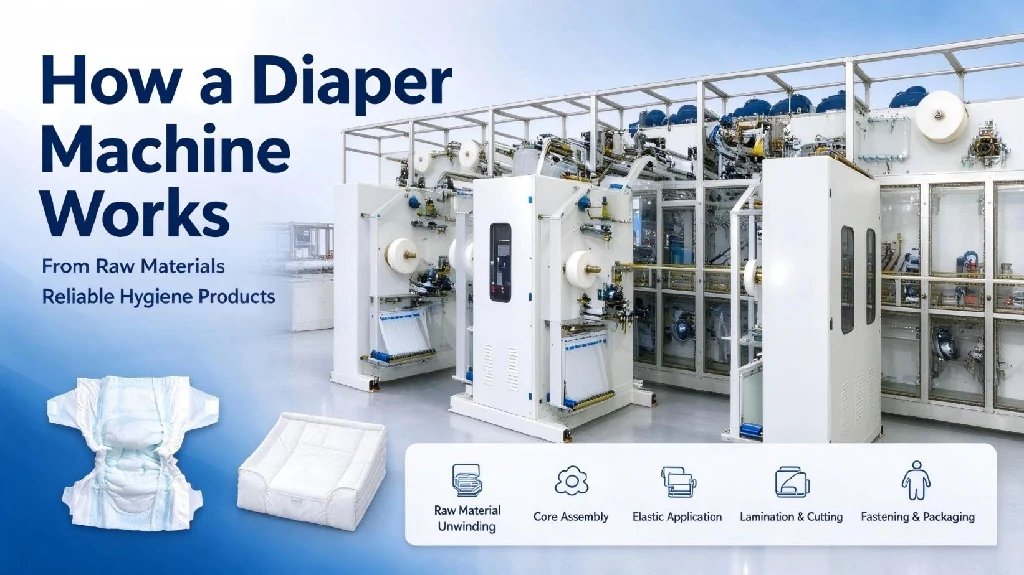
A modern diaper production line integrates multiple processes, including raw material feeding, absorbent core formation, material lamination, elastic application, product cutting, quality inspection, and packaging. Each stage contributes to the final product’s absorbency, fit, comfort, and overall quality.
This guide explains the main stages of diaper manufacturing and the equipment involved in each process.
1. Raw Materials Used in Diaper Manufacturing
Before production begins, different raw materials must be prepared and loaded onto the machine. Each material serves a specific function in the finished diaper.
The main materials include:
Nonwoven Fabric: Used as the topsheet and other structural layers. It provides a soft surface and allows liquid to pass through.
PE Film: Used as the waterproof backsheet to help prevent liquid leakage.
Fluff Pulp: Provides bulk and forms the fibrous structure of the absorbent core.
Super Absorbent Polymer (SAP): Absorbs and retains liquid, helping keep the diaper dry.
ADL (Acquisition Distribution Layer): Helps distribute liquid across the absorbent core.
Spandex: Provides elasticity around the waist and leg openings for a better fit.
Hot Melt Adhesive: Bonds different layers and components together.
Fastening Materials: Hook-and-loop tapes or frontal tapes are used in tape-style diapers.
The selection and quality of these materials directly affect the absorbency, softness, flexibility, and performance of the finished product.
2. Raw Material Unwinding and Feeding
The first stage of production is raw material unwinding and feeding.
A diaper making machine is equipped with multiple unwinding units that continuously feed different materials into the production system. These materials must maintain stable tension and accurate positioning throughout the process.
Automatic tension control and material alignment systems help reduce wrinkles, material deviation, and unnecessary waste.
At this stage, the topsheet, backsheet, absorbent materials, elastic components, and other materials are prepared for subsequent processing.
Stable material feeding is essential because any misalignment can affect the accuracy of downstream operations.
3. Absorbent Core Formation
The absorbent core is one of the most important components of a disposable diaper. Its structure and material distribution directly influence liquid absorption and retention.
In a typical production process, fluff pulp is processed into fine fibers and combined with SAP according to the required product specifications.
The mixture is then distributed through a forming system to create an absorbent core with a controlled shape and density.
Vacuum systems help distribute the fibers and SAP more evenly, while the forming unit determines the dimensions and structure of the core.
The absorbent core is then combined with other material layers to form the main body of the diaper.
For manufacturers producing different diaper sizes or absorbency levels, the core forming system must be configured according to the intended product specifications.
4. Material Lamination and Elastic Application
After core formation, the absorbent core is integrated with the topsheet, backsheet, and other functional materials.
Hot melt adhesive and other bonding methods are used to connect the different layers and maintain structural stability.
Elastic components are also applied during this stage.
Spandex is commonly used around the waist and leg areas to improve the fit of the finished diaper. The tension and positioning of the elastic threads must be carefully controlled to achieve the required elasticity and comfort.
Depending on the diaper design, the machine may also incorporate standing leg cuffs and other leakage protection structures.
These components help reduce side leakage and improve the overall wearing experience.
5. Product Shaping and Cutting
Once the main material layers have been assembled, the production line moves to product shaping and cutting.
Rotary cutting systems are used to cut the continuous material web into individual diaper shapes according to the required dimensions.
The cutting process determines important product features, including:
- Overall diaper shape and dimensions
- Leg opening structure
- Side panels
- Waist area
- Product outline
The cutting system must work in synchronization with the material feeding and bonding units to maintain consistent product dimensions.
Different diaper types require different cutting structures and mold configurations.
For example, adult diapers generally have larger product dimensions than baby diapers, while T-shape baby diapers require specific shaping and cutting arrangements.
6. Fastening System and Functional Component Application
For tape-style diapers, fastening components are applied to allow users to secure and adjust the diaper during wearing.
These may include hook tapes, frontal tapes, and side fastening components.
Some production lines can also incorporate additional functional features, such as wetness indicator lines, depending on the product design and machine configuration.
The positioning and bonding accuracy of these components are important for ensuring reliable product performance.
7. Quality Inspection and Automatic Packaging
Before packaging, finished diapers undergo quality inspection to identify possible production defects.
Depending on the machine configuration, inspection systems may include sensors, cameras, and automatic rejection devices.
Typical inspection points include:
- Material alignment
- Product dimensions
- Elastic application
- Adhesive bonding
- Absorbent core distribution
- Missing or defective components
After inspection, qualified products are transferred to the packaging section.
Automatic packaging equipment can count diapers, arrange them into groups, wrap them in packaging film, and seal the finished packs.
Further downstream equipment can handle carton packing and palletizing, depending on the factory’s production requirements.
8. Different Products Require Different Diaper Production Lines
Although baby diapers, adult diapers, and underpads share some basic manufacturing principles, their structures and production requirements are different.
Choosing the correct production equipment is therefore essential.
Baby Diaper Production Line
Designed for manufacturing baby diapers in different sizes. The production process focuses on product softness, fit, absorbency, and reliable leakage protection.
Adult Diaper Production Line
Designed for larger products with different absorbency requirements and structural configurations. Equipment selection depends on whether the manufacturer produces tape-style adult diapers or pull-up pants.
T-Shape Baby Diaper Production Line
Designed for specific T-shaped baby diaper structures, with corresponding cutting and forming arrangements.
Underpad Production Line
Used to manufacture disposable underpads for beds, chairs, medical facilities, and personal care applications. Compared with diapers, underpads generally have a flatter and simpler product structure.
Each production line should be configured according to the product design, required output, and factory operating conditions.
9. Semi-Servo vs. Full-Servo Diaper Making Machines
Machine control technology is another important consideration when planning a diaper manufacturing project.
Two common configurations are semi-servo and full-servo systems.
Semi-Servo Diaper Making Machine
A semi-servo machine combines servo-controlled functions with traditional mechanical transmission components.
It offers a balance between equipment investment, production performance, and maintenance requirements. It can be a practical option for manufacturers starting with medium-scale production.
Full-Servo Diaper Making Machine
A full-servo machine uses servo motors to control more of the production functions independently.
This configuration offers greater flexibility in adjusting production parameters and coordinating different operating units. It is particularly suitable for manufacturers requiring higher production capacity, more frequent product changes, or precise process control.
The right choice depends on the target output, product specifications, investment budget, and long-term production plan.
10. How to Choose the Right Diaper Manufacturing Machine
Selecting a diaper production line involves more than comparing machine prices or maximum production speeds.
Manufacturers should consider several factors before making an investment:
1.Product Type: Baby diapers, adult tape diapers, pull-up pants, or disposable underpads.
2.Production Capacity: Required output per minute and expected daily production.
3.Machine Configuration: Semi-servo or full-servo technology.
4.Product Specifications: Available sizes, dimensions, absorbency requirements, and product structure.
5.Factory Conditions: Available installation space, electricity supply, compressed air, and other utilities.
6.Investment Budget: Machine cost, auxiliary equipment, raw materials, installation, and operating expenses.
7.Technical Support: Installation, commissioning, operator training, spare parts, and after-sales service.
A properly configured production line helps manufacturers establish a stable manufacturing process and develop products that meet their target market requirements.
Conclusion
Disposable diaper manufacturing is a coordinated process that combines material science, mechanical engineering, and automation technology.
From raw material preparation and absorbent core formation to lamination, cutting, inspection, and packaging, every stage plays an important role in determining the quality of the finished product.
For businesses entering the hygiene products industry or expanding their existing operations, understanding these processes makes it easier to evaluate equipment configurations and plan a suitable production project.
Whether you are looking for a baby diaper machine, adult diaper production line, pull-up pants machine, or underpad production equipment, choosing machinery based on your product requirements and production objectives is the foundation of a successful manufacturing operation.
Looking for a suitable diaper manufacturing solution?
Contact our team to discuss your product type, target production capacity, machine configuration, and project requirements. We can help you evaluate suitable equipment and develop a production line solution based on your manufacturing needs.


