
How Is Advanced Automation Changing Modern EVA Footwear Production Lines?
October 2, 2026
Advanced automation is changing EVA footwear production by connecting material feeding, injection, molding, temperature control, demolding, inspection, and production data. For manufacturers, the goal is not simply to add more automatic functions. A modern EVA production line should reduce manual handling, improve process consistency, shorten unnecessary downtime, and provide useful production data. The right automation level depends on product type, output targets, mold configuration, factory layout, and labor structure.
EVA footwear production involves several variables that can affect final product quality. Material preparation, injection conditions, mold temperature, pressure, foaming behavior, cooling, and demolding all influence the finished component. Manual intervention at each stage can create variation between operators and production batches.
An automated EVA shoe making machine can coordinate these operations through programmed controls and sensors. A production line can also connect individual machines with material handling and inspection systems. This creates a more consistent production workflow.
Consider a factory producing 15,000 pairs of EVA slippers per day. Operators manually record machine settings, production quantities, and rejected pieces. A process change may remain unnoticed until several batches have been completed. With automated data collection, the production team can identify deviations earlier and trace them to a specific machine, mold, shift, or process condition.
Automation therefore has two roles. The first role involves physical machine operation. The second involves collecting and using production information.
For a footwear manufacturer, both roles matter when planning an automated EVA footwear production line.
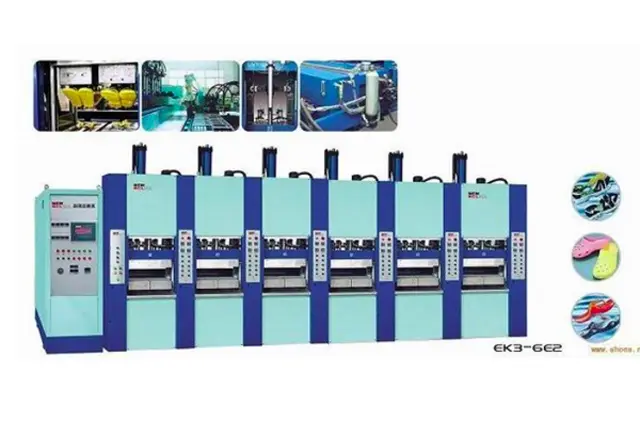
What Does Automation Mean in an EVA Footwear Production Line?
Automation in EVA footwear production does not mean that every production step needs a robot.
A practical automated line may combine automatic material feeding, programmable injection, temperature control, mold movement, cooling, demolding, counting, and data recording.
The level of automation should match the production process.
A small factory producing several custom designs may need flexible machine controls and easier mold changes. A large factory producing standard slippers may place more emphasis on automatic handling and continuous production.
Automatic Material Handling
Material handling represents one of the first areas where automation can reduce repetitive manual work.
EVA compounds may require controlled feeding into the injection system. An automated feeding arrangement can regulate material supply according to the machine’s production requirements.
The system can also reduce unnecessary operator intervention.
Material handling becomes more important when the factory runs multiple machines. Manual loading across many machines creates additional labor movement and increases the chance of inconsistent feeding.
A centralized or machine-level automatic feeding system can create a more predictable workflow.
Programmable Process Control
Modern machine controllers can store and manage production parameters.
These parameters may include temperature, pressure, injection time, holding time, mold conditions, and other process settings.
Operators can use predefined recipes for different products.
For example, a factory may produce three slipper designs using different molds. Each product can have its own approved process recipe.
The operator selects the correct recipe before production begins.
This approach reduces manual parameter entry and helps maintain consistent settings between production batches.
Automated Mold Movement
Mold handling can also become part of the automation system.
Rotary equipment uses a rotating platform to move molds through different stations. Other machine designs can use linear movement or automated transfer systems.
The objective remains similar. The system controls mold positioning and timing according to the production sequence.
Accurate movement matters because the mold must reach each station at the correct stage of the cycle.
A timing error can interrupt the production sequence and create unnecessary downtime.
Automatic Demolding
Demolding is another repetitive operation that can benefit from automation.
The finished EVA component must leave the mold without excessive deformation or damage.
Automated ejector systems can coordinate demolding with the mold cycle.
The exact mechanism depends on mold construction and product geometry.
Complex products may still require manual inspection after demolding. Automation should therefore support quality control rather than assume that every product requires no human involvement.
Which Automation Technologies Matter Most for EVA Footwear Production?
Not every automated function produces the same operational value.
Manufacturers should focus on technologies that affect production consistency, machine utilization, labor requirements, and traceability.
Sensors and Real-Time Monitoring
Sensors provide the machine with information about its operating conditions.
Temperature sensors can monitor heating zones and mold conditions. Pressure sensors can track injection behavior. Position sensors can confirm machine movement.
The controller can use these signals to adjust or stop a process when conditions move outside defined limits.
For example, if a mold does not reach the required temperature, the controller can prevent the next production step from starting.
This creates a basic interlock between process conditions and machine operation.
PLC-Based Control
Programmable logic controllers, or PLCs, form the control foundation of many industrial automation systems.
A PLC can coordinate valves, motors, heating systems, sensors, cylinders, and other components.
For an EVA footwear machine, the PLC can manage the sequence of injection, mold closing, heating, cooling, opening, and demolding.
The exact architecture depends on machine design.
A well-organized control system also makes troubleshooting easier because technicians can identify the operating status of individual components.
Human-Machine Interface
An HMI gives operators access to machine settings and production information.
A useful interface should display the parameters that operators actually need.
Typical information can include:
- Current temperature
- Injection pressure
- Cycle status
- Production count
- Alarm status
- Recipe selection
- Maintenance reminders
- Machine operating time
Clear information reduces the need for operators to interpret multiple control panels.
It also makes training easier when several operators share the same production equipment.
Automatic Data Collection
Production data becomes more useful when the machine records it automatically.
A factory can collect cycle times, output quantities, alarm events, temperature values, and downtime.
This information can support production analysis.
For example, a supervisor may notice that one machine has a longer average cycle than other machines. The team can then check the mold, heating system, injection conditions, or maintenance history.
Without data, the same issue may remain hidden.
How Can Automation Improve EVA Shoe Production Quality?
Automation can reduce process variation by controlling repeatable operations.
However, automation does not automatically guarantee product quality.
The machine still needs suitable materials, molds, process parameters, maintenance, and quality procedures.
Consistent Temperature Control
Temperature affects EVA processing behavior.
A production system needs controlled heating conditions to achieve repeatable results.
Automated temperature control can continuously monitor the relevant zones.
The controller can compare actual temperature with the target value and adjust the heating system.
This creates a closed-loop process rather than relying only on manual observation.
Consistent Injection Conditions
Injection conditions can affect material distribution inside the mold.
Changes in pressure, speed, or injection timing can influence the final product.
An automated system can store these parameters within the production recipe.
When the factory repeats the same product, the operator can use the approved settings instead of manually entering each value.
This can reduce variation between shifts.
Repeatable Cooling and Demolding
Cooling also affects production timing.
If one batch receives significantly different cooling conditions from another, the product may show dimensional or handling differences.
Automated cycle control can maintain the defined cooling period.
The machine can then move to the next stage according to the programmed sequence.
This approach also helps production planning because the expected cycle becomes easier to calculate.
How Does Automation Affect EVA Slipper Production?
Slippers represent a major application for EVA molding because the product can require repeated production across multiple sizes and designs.
A factory may run the same design in several sizes, colors, or patterns.
This creates a production environment where automated recipes, mold identification, counting, and handling can provide practical benefits.
One-Color Slipper Production
One-color production often has a relatively straightforward material and molding configuration.
A suitable EVA foaming machine can support a production workflow centered on controlled molding conditions.
Automation can store product-specific settings for different sizes.
For example, size 38 and size 42 may use different mold configurations. The production team can associate each mold with a predefined process recipe.
This reduces the chance of using incorrect parameters after a mold change.
Two-Color Slipper Production
Two-color products introduce additional process requirements.
The machine needs to coordinate material injection and mold operation for the selected design.
A suitable EVA slipper foaming machine can support two-color slipper production where the machine configuration matches the required mold and material process.
Automation becomes useful because timing becomes more important.
The system must coordinate injection stages, mold positioning, and cycle timing.
Manual control can still play a role during setup and product inspection. However, repetitive production steps can run according to stored parameters.
What Does a Modern Automated EVA Production Line Look Like?
An automated EVA footwear line can combine several machine and information layers.
At the physical level, the line handles materials, molds, products, and machine movements.
At the control level, PLCs and sensors manage process conditions.
At the information level, software records production data and machine status.
These three layers can work together.
Layer 1: Material and Machine Operations
This layer includes:
- EVA material feeding
- Injection units
- Heating systems
- Hydraulic or mechanical movement
- Mold clamping
- Cooling
- Demolding
The machine performs the physical production process.
Layer 2: Process Control
The control system manages machine timing and process parameters.
Sensors provide feedback.
The PLC processes the signals and controls the relevant components.
This creates the operating logic of the machine.
Layer 3: Production Information
The information layer records production events.
It can include output, cycle time, machine status, alarms, and process parameters.
Larger factories may connect these records with production management systems.
This allows managers to evaluate production performance without relying entirely on handwritten records.
How Can Manufacturers Use Production Data?
Data collection becomes valuable when the factory uses the information to support specific decisions.
A large production line may generate thousands of cycle records every week.
Simply storing this information provides limited value.
The production team should define which indicators matter.
Cycle Time
Cycle time shows how long the machine needs to complete a defined production cycle.
A gradual increase may indicate mold issues, heating problems, material changes, or maintenance requirements.
Comparing cycle times across machines can also reveal production differences.
Downtime
Downtime records identify when and why production stops.
A machine may stop because of material shortages, temperature alarms, mold changes, mechanical faults, or operator intervention.
Categorizing downtime makes the data easier to analyze.
Production Quantity
Automatic counting provides a more consistent production record.
The system can compare planned quantity with actual output.
This helps supervisors identify production gaps during a shift.
Reject Rate
Quality data can be linked with production records.
For example, the factory may notice that rejection rates increase after a particular mold reaches a certain number of cycles.
That pattern may justify mold inspection or maintenance.
What Role Does Machine Vision Play in EVA Footwear Production?
Machine vision can support automated inspection when product geometry and quality criteria allow reliable image recognition.
A camera system can inspect dimensions, surface appearance, color differences, or visible defects.
The exact inspection capability depends on the product.
For example, a vision system may identify an obvious surface defect on a flat EVA sole. More complex three-dimensional products may require multiple cameras or additional measurement methods.
Automated Visual Inspection
A typical vision system includes a camera, lighting, image-processing software, and a defined inspection standard.
The system captures the product after demolding.
Software compares the image against predefined criteria.
Products outside the defined criteria can then move to a separate inspection area.
Human inspectors remain useful for defects that require subjective judgment or tactile evaluation.
Automation works best when the inspection criteria remain measurable and repeatable.
How Can Automation Reduce Labor Pressure?
Labor remains important in EVA footwear production.
Automation does not necessarily eliminate operators. Instead, it changes their role.
Instead of manually controlling every machine movement, operators can focus on material preparation, mold changes, inspection, troubleshooting, and production supervision.
This can reduce repetitive work.
Operator Role Before Automation
A manual workflow may require operators to:
- Load material
- Adjust parameters
- Monitor temperatures
- Move molds
- Start cycles
- Remove products
- Count output
- Record production data
The workload increases as the number of machines grows.
Operator Role With Higher Automation
A more automated line can shift the operator’s focus toward:
- Recipe selection
- Material verification
- Mold setup
- Process monitoring
- Quality checks
- Alarm response
- Maintenance coordination
This changes the skills required on the factory floor.
Operators need to understand machine controls and production parameters rather than only performing repetitive manual tasks.
How Should a Factory Calculate the Value of Automation?
Automation investment should use measurable production factors.
The machine purchase price represents only one part of the calculation.
A factory should also consider labor, downtime, energy, scrap, maintenance, production capacity, and future expansion.
| Factor | Manual or Lower Automation | Higher Automation |
|---|---|---|
| Parameter entry | More operator involvement | Recipe-based control |
| Material handling | Manual or semi-automatic | Automated options |
| Production counting | Manual recording | Automatic counting |
| Process monitoring | Operator observation | Sensor-based monitoring |
| Data collection | Paper or spreadsheets | Digital records |
| Repetitive handling | Higher labor demand | Reduced manual handling |
| Alarm response | Operator identification | Automatic alarms and interlocks |
| Quality inspection | Mainly manual | Manual plus automated options |
| Traceability | Depends on records | Easier with integrated data |
The actual financial effect depends on the factory’s production volume and local labor costs.
A high-volume factory may gain more from automation than a small factory with irregular production.
Calculate Payback From Actual Production Data
Suppose automation reduces two operator positions per shift.
The factory should calculate annual labor savings based on actual wages and working hours.
Then add measurable effects from reduced downtime and lower scrap.
Subtract additional maintenance and energy costs.
The result provides a more realistic basis for investment planning.
Avoid calculating payback from machine price alone.
What Should Buyers Look for in an Automated EVA Shoe Making Machine?
Machine specifications should match the intended production process.
A factory should review both mechanical and control-system specifications.
Mechanical Requirements
Important factors may include:
- Injection capacity
- Clamping force
- Mold dimensions
- Station quantity
- Mold thickness
- Heating capability
- Cooling arrangement
- Product size range
These specifications determine whether the machine can physically produce the intended footwear.
Control Requirements
The control system deserves equal attention.
Buyers should ask about:
- PLC manufacturer
- HMI configuration
- Recipe storage
- Temperature control
- Alarm management
- Data export
- Production counting
- Remote diagnostics
- Parameter access levels
The purpose is not to select the longest specification list.
The goal is to ensure that the control system supports the factory’s actual workflow.
Automation Compatibility
A future production upgrade may require communication between machines.
Buyers should therefore ask whether the machine can connect with external production systems.
This becomes relevant when the factory plans to introduce centralized production monitoring later.
An expandable architecture can reduce the need for major control-system replacement.
How Can Automation Support Multi-Product EVA Production?
Footwear factories rarely produce only one product forever.
A manufacturer may produce slippers during one season and introduce sandals or shoe soles later.
The production system must therefore handle product changes.
Recipe management can help.
Each product can have defined parameters linked to its mold and material configuration.
The operator selects the correct product recipe during setup.
Example: Three Product Families
Imagine a factory producing:
- One-color slippers
- Two-color sandals
- EVA shoe soles
Each product may require different mold dimensions and process settings.
The control system can store separate recipes.
The operator changes the mold, confirms the material, selects the approved recipe, and performs the required setup checks.
This does not remove the need for technical verification.
Instead, it creates a more controlled transition between production batches.
What Are the Risks of Over-Automating an EVA Production Line?
Automation has limits.
Adding more sensors, robots, conveyors, and software does not automatically create a better production system.
Complexity can increase maintenance requirements.
A small factory may not benefit from a highly integrated system if production volume does not justify the investment.
Another concern involves technician capability.
If the factory lacks personnel who understand PLCs, sensors, drives, and industrial controls, troubleshooting may take longer.
Spare parts also matter.
The factory should identify critical components before commissioning the line.
These may include sensors, valves, heating elements, controllers, drives, seals, and other wear components.
A practical automation plan should therefore balance functionality with maintainability.
How Should a Factory Plan an EVA Production Automation Upgrade?
Factories do not always need to automate everything at once.
A staged approach can reduce technical and financial pressure.
Stage 1: Automate Core Machine Functions
Start with stable temperature control, programmable process parameters, automatic counting, and alarm management.
These functions directly support the molding process.
Stage 2: Improve Material and Mold Handling
The next stage can address repetitive movement.
Material feeding, mold handling, and product transfer can receive automation where the production volume justifies it.
Stage 3: Add Production Data Management
Once machine-level data becomes reliable, the factory can connect production records.
Managers can then analyze cycle time, downtime, output, and quality trends.
Stage 4: Integrate Inspection
Machine vision or automated measurement can be introduced for products with clearly defined inspection criteria.
This stage requires careful testing.
The system must distinguish acceptable variation from actual defects.
What Questions Should Buyers Ask an EVA Machine Supplier?
A technical discussion should focus on the complete production line.
Ask the supplier to provide actual production assumptions.
Useful questions include:
- What output does the machine achieve with our specific product?
- What mold size can the machine accept?
- How many cavities can each mold contain?
- What cycle time applies to our product?
- Which process parameters can the PLC control?
- How many recipes can the HMI store?
- Can production data be exported?
- Which components require regular replacement?
- What happens if a temperature sensor fails?
- Can the machine connect with external automation?
- What training does the supplier provide?
- Which spare parts should the factory keep locally?
Product samples and mold drawings can improve the technical discussion.
A supplier can then evaluate machine configuration based on actual production requirements.
Contact Bayeux to discuss automated EVA footwear production equipment for your factory requirements.
FAQ About Automation in EVA Footwear Production
What is an automated EVA shoe making machine?
An automated EVA shoe making machine uses programmable controls, sensors, and automated mechanical functions to manage parts of the molding process.
The exact automation level varies by machine model.
Can automation improve EVA footwear production consistency?
Automation can reduce variation in repeatable machine operations.
However, product consistency also depends on material formulation, mold condition, process settings, and maintenance.
What functions can an EVA shoes machine automate?
Depending on the configuration, automation can cover material feeding, injection, temperature control, mold movement, cooling, demolding, counting, alarms, and production data recording.
Is a fully automatic EVA footwear machine necessary for every factory?
No.
The appropriate automation level depends on production volume, product mix, labor costs, factory layout, and investment plans.
A smaller manufacturer may benefit more from automating critical process controls first.
Can an EVA slipper making machine store different product settings?
Many modern machines can store multiple production recipes.
The exact number and functionality depend on the control system.
Does automation reduce the need for operators?
Automation can reduce repetitive manual tasks, but operators remain important.
They still handle setup, mold changes, quality checks, troubleshooting, material verification, and maintenance coordination.
Can production data be collected from an EVA footwear machine?
Many modern machines can record information such as cycle time, production quantity, alarms, and process parameters.
The available data depends on the machine’s control architecture.
Can machine vision inspect EVA shoes automatically?
Machine vision can inspect certain measurable visual characteristics.
Its effectiveness depends on product geometry, lighting, defect type, inspection criteria, and system configuration.
How can automation help reduce production downtime?
Automated alarms and machine monitoring can identify abnormal conditions earlier.
Production records can also help maintenance teams identify recurring downtime causes.
What should I provide when buying an automated EVA shoe machine?
Provide product samples or drawings, product weight, dimensions, EVA material information, color requirements, target output, mold specifications, factory space, and power conditions.
These details help the supplier determine the required machine configuration.
References
- U.S. Department of Energy, Industrial Technologies and Manufacturing Resources:
https://www.energy.gov/eere/amo/advanced-manufacturing - International Organization for Standardization, ISO 22400, Automation Systems and Integration: Key Performance Indicators for Manufacturing Operations Management:
https://www.iso.org/standard/56847.html - International Federation of Robotics, Industrial Robot Statistics and Manufacturing Automation Resources:
https://ifr.org/ - Dow, ELVAX™ Ethylene Vinyl Acetate Copolymer Technical Information:
https://www.dow.com/en-us/pdp.elvax-460-ethylene-vinyl-acetate-copolymer.1893117z.html - Springer Nature, Research on EVA Materials and Footwear Manufacturing:
https://link.springer.com/article/10.1007/s00170-023-11332-1
Bayeux supplies EVA footwear production machinery for manufacturers producing slippers, shoes, soles, and related EVA products. Its equipment solutions support different molding configurations and production requirements. Bayeux works with footwear manufacturers to match machine structure, automation functions, mold requirements, and output targets with the actual production process.


