
How Do EVA Injection Molding Machines Work for High-Volume Footwear Production?
September 18, 2026
EVA injection molding machines produce footwear by heating EVA material, injecting it into shaped molds, controlling expansion and curing, then releasing the finished components after the material reaches the required structure. The machine must coordinate material preparation, injection pressure, mold temperature, curing time, station movement, and demolding conditions.
This process differs from ordinary thermoplastic injection molding because EVA footwear production often depends on controlled foaming and crosslinking. These stages influence density, flexibility, dimensions, surface finish, and overall product consistency.
For manufacturers producing slippers, sandals, soles, and other EVA footwear, the machine configuration directly affects production capacity and product quality. Multi-station systems can also support continuous production by allowing several molds to operate through different stages of the cycle.
Understanding how the machine works helps manufacturers evaluate equipment beyond the basic number of stations. Material behavior, mold design, heating control, injection parameters, cycle time, and product requirements all need to work together.
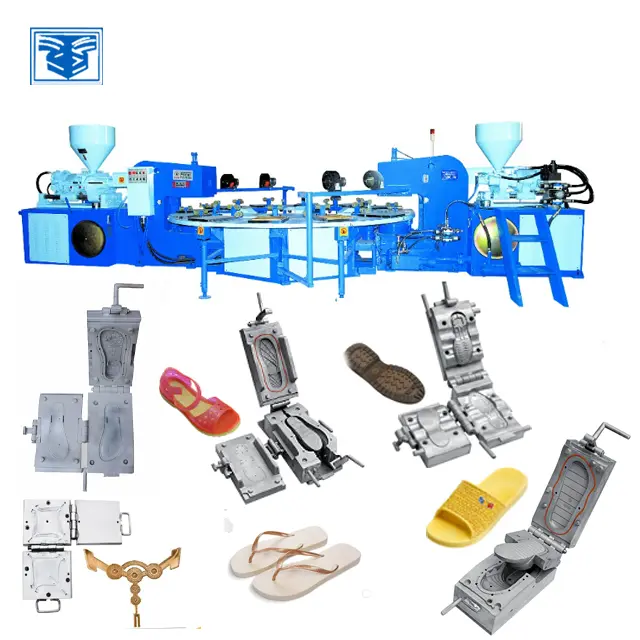
What Happens Inside an EVA Injection Molding Machine?
An EVA injection molding machine converts prepared EVA material into a molded footwear component through several controlled stages.
Although the exact process varies according to machine design and material formulation, the production sequence generally includes material preparation, feeding, plasticizing, injection, molding, curing or foaming, cooling, and demolding.
1. EVA Material Preparation
EVA, or ethylene-vinyl acetate, is widely used in footwear because its properties can be adjusted through formulation. EVA compounds can provide flexibility, resilience, low density, and cushioning characteristics.
The material formulation may include EVA resin, blowing agents, crosslinking agents, pigments, fillers, and other additives.
The formulation determines how the material behaves during processing. Therefore, manufacturers should establish the material recipe before setting machine parameters.
Different footwear products may require different material characteristics. A lightweight slipper, a dense outsole, and a cushioning midsole do not necessarily use the same formulation or processing conditions.
2. Feeding and Plasticizing
Prepared EVA material enters the machine through the feeding system.
The material then moves toward the plasticizing section, where heat and mechanical action prepare it for injection. The objective is to achieve a sufficiently uniform material state without creating unnecessary degradation.
Temperature control matters because EVA must reach a suitable processing condition before injection. Excessive heat can affect the material, while insufficient plasticization can cause inconsistent filling.
3. Injection Into the Mold
The plasticized EVA compound is injected into the mold cavity.
Injection pressure and speed influence how completely the material fills the cavity. The mold must receive enough material to reproduce the intended footwear geometry.
The injection stage also needs to account for the formulation’s later expansion and curing behavior.
This is one reason why EVA footwear production cannot be treated as a simple mold-filling operation. The final dimensions depend on what happens after injection as well.
4. Foaming and Crosslinking
Many EVA footwear formulations use chemical foaming and crosslinking.
During controlled heating, the blowing system generates gas while the polymer structure develops the required crosslinked state. This creates the cellular structure responsible for many of EVA’s lightweight and cushioning characteristics.
The timing of these reactions is important.
If expansion occurs too early or too aggressively, the material may not reproduce the intended shape. If the material does not develop its required structure correctly, the finished product may show differences in density, hardness, dimensions, or resilience.
5. Mold Opening and Demolding
After the material reaches the required condition, the mold opens and the finished component can be removed.
Demolding must occur at an appropriate stage. Removing the product too early can affect dimensional stability, while excessive processing time can reduce production efficiency.
This stage becomes particularly important in high-volume production because repeated opening, closing, injection, curing, and demolding must remain consistent across many cycles.
Why Does Mold Temperature Matter in EVA Footwear Production?
Mold temperature plays an important role in EVA injection molding because the mold participates in the heating and curing process.
A footwear mold does more than define the external shape. It also transfers heat into the material and helps establish the conditions required for foaming and crosslinking.
Temperature distribution should therefore remain consistent across the mold.
If different regions receive significantly different thermal conditions, the finished product may show variations in density, expansion, surface appearance, or dimensions.
Mold Design and Heat Transfer
Footwear molds often contain detailed features.
Sole patterns, logos, grooves, raised areas, and other design elements must transfer accurately to the EVA compound.
The mold must therefore combine appropriate cavity geometry with controlled heating.
For high-volume production, repeatability becomes especially important. A small thermal difference may appear insignificant during one cycle, but repeated across thousands of products, it can create measurable variation.
Temperature and Cycle Time
Mold temperature also affects cycle time.
A machine operating at an unsuitable temperature may require longer processing to reach the required material condition. Excessive temperature can create other problems, including premature reactions or material degradation.
The appropriate temperature therefore depends on the EVA formulation, product geometry, mold design, and machine configuration.
Manufacturers should establish processing parameters through material and mold trials rather than treating one temperature setting as universal.
How Does the Injection Process Affect EVA Shoe Quality?
Injection conditions influence filling, material distribution, surface appearance, and the consistency of the finished footwear.
Several parameters work together.
Injection Pressure
Injection pressure must provide sufficient force to fill the cavity.
Too little pressure may contribute to incomplete filling or visible defects. Excessive pressure may create unnecessary material stress or influence the filling behavior.
The correct range depends on the material and mold.
Injection Speed
Injection speed affects how the material enters the cavity.
A suitable speed helps maintain consistent filling and reduces unwanted variation between production cycles.
Complex footwear molds may contain thin sections, deep patterns, or multiple design details. These features can make filling behavior more sensitive to injection conditions.
Material Quantity
The amount of material injected into each cavity must also remain consistent.
Variation in shot weight can influence final product weight and dimensions. In high-volume footwear production, stable metering therefore becomes an important part of quality control.
Mold Filling and Product Geometry
Different footwear designs create different processing requirements.
A simple flat slipper may have relatively straightforward geometry. A contoured sole with multiple thicknesses, deep tread patterns, or integrated decorative features may require more careful process control.
Manufacturers should evaluate the complete mold and material combination rather than selecting a machine based only on nominal injection capacity.
How Does a Multi-Station EVA Shoe Making Machine Increase Production Capacity?
A multi-station EVA shoe making machine increases production capacity by allowing several molds or production positions to participate in the manufacturing cycle.
Instead of treating every product as a completely separate machine cycle, the equipment coordinates multiple stations through a continuous production sequence.
This configuration can be useful for manufacturers producing large quantities of similar EVA footwear.
For example, a machine may contain multiple working stations that move through injection, heating, curing, cooling, and demolding stages.
The exact arrangement depends on the equipment design.
2-Station Configuration
A 2-station EVA system can provide a relatively compact solution for manufacturers with moderate production requirements.
The configuration can be suitable when production volume does not justify a larger multi-station system or when manufacturers want to maintain a more compact equipment layout.
Bayeux offers a 2 station EVA injection shoes machine for this type of production setup.
4-Station Configuration
A 4-station system provides additional production positions and can support higher output requirements.
The additional stations allow production activities to be distributed across the machine cycle more efficiently.
For manufacturers producing multiple EVA slipper designs, a 4 station EVA slipper machine can provide a practical balance between machine configuration and production capacity.
6-Station Configuration
As production requirements increase, a 6-station machine can provide more working positions within the same production system.
A 6 station EVA shoes machine is designed for manufacturers looking for a more automated and higher-capacity production arrangement.
8-Station Configuration
An 8-station configuration further increases the number of coordinated production positions.
For high-volume footwear manufacturing, an 8 station EVA slipper machine can provide a larger production platform.
However, more stations do not automatically mean better economics for every factory.
Manufacturers should compare expected demand, product mix, floor space, labor requirements, mold investment, utilities, and actual cycle time before choosing the station count.
What Determines the Output of an EVA Footwear Machine?
Machine output depends on more than the number of stations.
A useful way to evaluate capacity is to consider the relationship between cycle time, number of working cavities, product configuration, and machine availability.
A simplified production calculation can be expressed as:
Output ≈ Available Production Time ÷ Effective Cycle Time × Products per Cycle
However, real production output also depends on downtime, mold changes, material preparation, inspection, maintenance, and other operational factors.
| Production Factor | Effect on Output |
|---|---|
| Number of stations | Determines how many production positions the machine can coordinate |
| Cycle time | Directly affects the number of completed cycles |
| Mold cavities | Influences products produced during each cycle |
| Injection speed | Affects material filling and processing time |
| Curing time | Can become a major part of the production cycle |
| Mold changeover | Affects effective machine utilization |
| Product size | Larger products may require different material and processing conditions |
| Material formulation | Influences expansion, curing, and cycle requirements |
| Machine downtime | Reduces actual production output |
| Operator workflow | Affects loading, demolding, inspection, and material handling |
For this reason, manufacturers should distinguish between theoretical machine capacity and actual production output.
A machine specification may describe a maximum output under defined conditions. Factory output depends on the complete production system.
How Does EVA Foam Expansion Affect the Final Footwear?
Foam expansion is one of the key characteristics that separates EVA footwear processing from conventional solid plastic injection.
The final EVA structure contains a cellular morphology created during the foaming process. The amount and uniformity of expansion influence product density and physical properties.
Density
Density affects the weight and feel of the finished footwear.
A lower-density EVA product may feel lighter and softer, while a higher-density formulation can provide a different balance of firmness and structural support.
However, lower density is not automatically better.
The correct density depends on the intended footwear application.
Expansion Ratio
The formulation and processing conditions determine how much the material expands.
If expansion varies across the product, the finished component may show differences in thickness or density.
This can become visible when comparing different areas of a sole.
Dimensional Stability
The product must reach a stable structure before final handling.
If the material continues changing significantly after demolding, the dimensions may shift.
This is why mold temperature, formulation, curing conditions, cooling, and demolding timing need to be considered together.
Surface Quality
Foaming behavior can also influence the surface.
A well-controlled process helps reproduce mold details consistently. Poor process control may produce visible defects or differences in surface texture.
What Are the Main Quality Problems in EVA Injection Molding?
EVA footwear production can encounter several recurring quality problems.
The cause is not always the machine itself. Material formulation, mold design, processing parameters, and operator settings can all contribute.
Incomplete Filling
Incomplete filling occurs when material does not fully reproduce the intended cavity.
Possible factors include insufficient injection pressure, unsuitable injection speed, material quantity, mold conditions, or formulation characteristics.
Uneven Density
Density differences may appear when material distribution or foaming is inconsistent.
The problem may become more noticeable in larger or more complex footwear components.
Dimensional Variation
Finished dimensions can vary when processing conditions change between cycles.
Temperature consistency, curing conditions, mold design, and material formulation all need to remain controlled.
Surface Defects
Surface problems can include incomplete pattern reproduction, marks, irregular textures, or other visual inconsistencies.
The mold surface and processing parameters should be inspected together when diagnosing these issues.
Product Sticking
Improper demolding conditions can make the product difficult to remove from the mold.
Mold design, surface condition, release practices, and processing temperature can all influence demolding behavior.
Color Variation
For colored EVA products, inconsistent pigment dispersion or material preparation can produce visible differences.
Manufacturers producing multiple colors should establish controlled material preparation procedures to maintain batch consistency.
How Should Manufacturers Select an EVA Shoe Making Machine?
Machine selection should start with the product rather than the machine model.
The most important questions concern what the factory plans to produce, at what volume, and with what material formulation.
1. Define the Product Range
Identify the main products first.
These may include:
- EVA slippers
- EVA sandals
- EVA soles
- lightweight footwear
- molded footwear components
- products with detailed surface patterns
Different product dimensions and mold structures can create different equipment requirements.
2. Estimate Real Production Demand
Calculate expected monthly production rather than selecting the largest available machine.
A higher-capacity machine requires more investment and may require additional floor space and utilities.
If production demand remains moderate, excessive capacity can increase equipment utilization pressure.
3. Evaluate Station Configuration
Compare 2-station, 4-station, 6-station, and 8-station configurations according to expected production requirements.
The correct station count depends on:
- target output
- product mix
- available floor space
- mold quantity
- labor arrangement
- investment budget
- future production plans
4. Check Mold Compatibility
The machine should match the intended mold dimensions and product range.
Manufacturers should confirm mold size, cavity arrangement, clamping requirements, heating configuration, and product dimensions before ordering equipment.
5. Review Material Processing Requirements
The machine should be compatible with the EVA formulations used by the factory.
This includes evaluating injection capacity, temperature control, processing conditions, and curing requirements.
6. Consider Automation
Automation can reduce manual handling and improve production consistency.
However, the appropriate automation level depends on the factory’s workflow.
A highly automated machine may not provide practical value if upstream material preparation and downstream handling remain heavily manual.
EVA Footwear Machine Selection: A Practical B2B Comparison
The following comparison provides a starting framework for evaluating machine configurations.
| Production Requirement | Suitable Direction | Key Considerations |
|---|---|---|
| Moderate production volume | 2-station configuration | Compact layout and controlled investment |
| Growing slipper production | 4-station configuration | Balance between capacity and equipment footprint |
| Higher-volume footwear production | 6-station configuration | More production positions and automation potential |
| Large-scale production | 8-station configuration | Higher capacity and greater system investment |
| Multiple product sizes | Flexible mold arrangement | Check mold compatibility and changeover |
| Multiple EVA formulations | Process control capability | Confirm temperature and injection adjustment range |
| High product consistency | Stable control system | Focus on temperature, injection, and cycle repeatability |
| Frequent product changes | Changeover efficiency | Evaluate mold replacement and operating workflow |
The table should not be treated as a universal machine selection rule.
Actual equipment requirements depend on product size, mold design, material formulation, cycle time, and factory production targets.
How Can Manufacturers Improve EVA Injection Molding Consistency?
Consistent footwear production requires control across the entire process rather than focusing on injection alone.
Standardize Material Preparation
Material formulation should remain consistent between production batches.
Manufacturers should control the proportions and preparation procedures for EVA resin, additives, pigments, blowing agents, and other formulation components.
Maintain Stable Processing Parameters
Once a validated production setting has been established, unnecessary changes should be avoided.
Key parameters include:
- injection pressure
- injection speed
- mold temperature
- heating time
- curing time
- material quantity
- cooling conditions
Parameter records can help operators identify process drift.
Monitor Mold Condition
The mold directly influences product geometry and surface appearance.
Regular inspection can identify wear, contamination, surface damage, or other conditions that may affect molding quality.
Control Cycle Consistency
A stable cycle helps reduce variation.
Operators should monitor whether the actual production cycle remains close to the validated process window.
Unexpected cycle changes can indicate problems with heating, material preparation, machine settings, or mold operation.
Separate Machine Problems From Material Problems
When defects appear, changing machine parameters immediately may not solve the issue.
Manufacturers should first determine whether the problem originates from:
- Material formulation
- Material preparation
- Machine settings
- Mold condition
- Heating system
- Demolding process
- Operator handling
This structured approach reduces unnecessary parameter adjustments.
What Is the Difference Between an EVA Shoe Machine and a Standard Plastic Injection Machine?
An EVA shoe making machine and a conventional plastic injection molding machine both use injection principles, but their production requirements can differ substantially.
A standard plastic injection machine commonly processes thermoplastics that melt, fill a mold, cool, and solidify.
EVA footwear production may involve additional foaming and crosslinking behavior.
The material therefore does not simply enter the mold as a conventional solid plastic and cool into its final form.
The machine must provide suitable control for the EVA formulation and the associated thermal process.
Product Geometry
Footwear molds often contain complex tread patterns, ergonomic contours, logos, textures, and varying thicknesses.
The machine and mold combination must reproduce these details while managing the material’s expansion behavior.
Heating Requirements
EVA processing can require controlled mold heating rather than relying only on cooling after injection.
This makes temperature management a central part of the equipment design.
Production Configuration
Footwear production also benefits from multi-station arrangements.
Several molds or production positions can operate within a coordinated cycle, helping factories achieve higher output without treating every pair as an isolated molding operation.
Material Behavior
EVA formulations can be engineered for different density, flexibility, resilience, and cushioning characteristics.
The equipment therefore needs to accommodate the specific formulation rather than applying a generic plastic injection setting.
FAQ
What is an EVA injection molding machine used for?
An EVA injection molding machine is used to produce molded EVA footwear and related components. Typical applications include slippers, sandals, soles, and other lightweight footwear products.
How does an EVA shoe making machine work?
The machine feeds and plasticizes EVA material before injecting it into a heated mold. The material then undergoes controlled foaming and crosslinking before the mold opens and the finished product is removed.
What is the difference between an EVA shoes machine and an EVA slipper machine?
The basic molding principle can be similar. The main difference usually relates to the product design, mold configuration, and production requirements rather than the basic injection process.
Does a higher number of stations always mean higher production?
A higher station count can increase production capacity, but actual output also depends on cycle time, mold cavities, product size, material formulation, machine utilization, and downtime.
What affects EVA footwear density?
Density depends on the EVA formulation, blowing system, expansion behavior, material quantity, mold conditions, temperature, and curing process.
Can one machine produce different EVA footwear designs?
Many EVA footwear machines can support different molds, but compatibility depends on the machine’s mold dimensions, working configuration, and product requirements.
What should manufacturers check before purchasing an EVA footwear machine?
Manufacturers should evaluate expected output, product dimensions, mold size, station configuration, material formulation, heating control, automation level, floor space, utilities, and future production requirements.
Why is mold temperature important in EVA footwear production?
Mold temperature affects heat transfer into the EVA material and therefore influences foaming, crosslinking, dimensional stability, surface reproduction, and cycle conditions.
What is an EVA footwear machine?
An EVA footwear machine is production equipment designed specifically for molding EVA-based footwear. Depending on its configuration, it may support slippers, sandals, soles, and other molded footwear products.
Is an EVA injection machine suitable for high-volume production?
Yes. Multi-station configurations can support high-volume EVA footwear manufacturing by coordinating several production positions within the molding cycle. The appropriate configuration depends on the required output and product range.
Why Choose Bayeux for EVA Footwear Production Equipment?
Bayeux develops machinery for manufacturers working with disposable products and molded footwear applications. Its EVA equipment range includes different station configurations for factories with different production requirements.
The product portfolio includes 2-station, 4-station, 6-station, and 8-station EVA footwear machines. This allows manufacturers to evaluate equipment according to production capacity instead of applying one configuration to every factory.
For a new EVA footwear production line, machine selection should consider the complete process. Product design, material formulation, mold configuration, cycle time, station count, automation, and expected output all influence the final equipment requirement.
Manufacturers can discuss their product dimensions, target output, mold requirements, and EVA formulation with Bayeux before selecting a machine configuration.
For equipment planning and technical requirements, contact Bayeux to discuss the appropriate EVA footwear production setup.
References
- Dow, ELVAX™ EVA Copolymer. EVA resin information and processing applications, including footwear and injection molding.
https://www.dow.com/en-us/pdp.elvax-460-ethylene-vinyl-acetate-copolymer.1893117z.html - Springer Nature, “Mechanical characterization and sustainability assessment of recycled EVA for footwear.” The study examines the mechanical behavior and potential use of recycled EVA in footwear applications.
https://link.springer.com/article/10.1007/s00170-023-11332-1 - Braskem, EVA Technical Information. Technical information covering EVA materials and footwear-related applications.
https://www.braskem.com/portal/Principal/arquivos/listas/15578/thumb.pdf - ExxonMobil Chemical, EVA 2018 Series. Technical information covering EVA grades and molding-related properties.
https://exxonmobilchemical.ulprospector.com/en-US/ds243663/ExxonMobil%E2%84%A2%20EVA%202018%20Series.aspx?I=58933&U=1 - Dow-Mitsui Polychemicals, EVAFLEX. EVA product information and material characteristics.
https://www.mdp.jp/en/product/eva.php - World Intellectual Property Organization / Google Patents, WO2016134836A1. Patent documentation concerning injection molding processes for EVA soles.
https://patents.google.com/patent/WO2016134836A1/en


