
What Determines the Production Efficiency of a Modern Diaper Machine?
November 20, 2026
A practical guide to machine speed, stable output, product quality, and operating performance
The hygiene products industry continues to evolve as manufacturers respond to changing consumer needs, expanding product portfolios, and growing expectations for consistent quality. In this environment, production equipment plays an important role in helping factories control costs, maintain product standards, and deliver orders on time. One question buyers often ask when evaluating a new production line is: How efficient is a modern diaper machine?
The answer involves more than the maximum speed listed on a technical specification sheet. A machine may be designed to operate at high speed, but its actual value depends on how consistently it runs, how many finished products meet quality requirements, how much material is wasted, and how quickly the line recovers from stoppages. For manufacturers planning a new project or upgrading existing equipment, understanding these factors makes it easier to compare suppliers and select a suitable configuration.
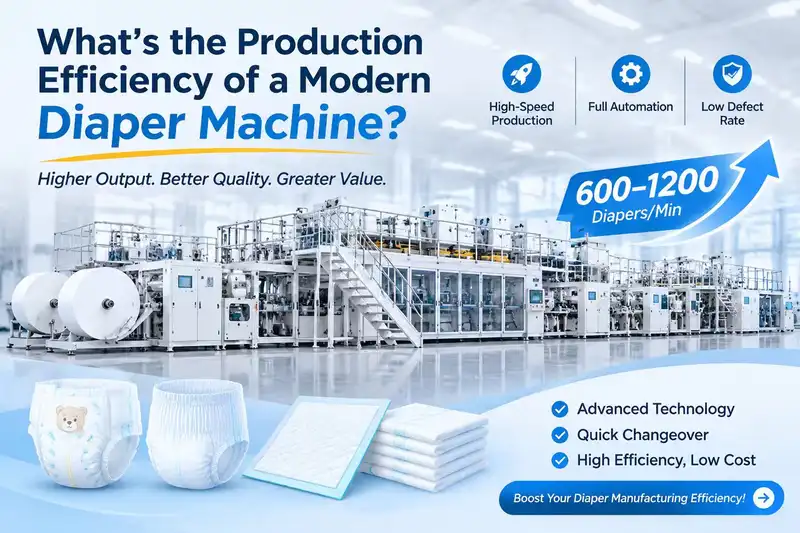
1. What Does Production Efficiency Really Mean?
Production efficiency describes how effectively a machine converts raw materials, labor, and operating time into finished products that meet the required specifications. In diaper manufacturing, output is commonly measured in pieces per minute (PPM) or pieces per hour. These figures are useful, but they should always be considered alongside product quality and operating conditions.
It is important to distinguish between three different speed figures. Designed speed is the maximum speed a machine is engineered to reach under defined conditions. Stable running speed is the speed it can maintain during normal production. Qualified output is the number of products that pass the factory’s quality inspection within a given period. The last figure is often the most useful for production planning because it reflects saleable products rather than theoretical capacity.
Overall Equipment Effectiveness (OEE) is another useful concept. It considers equipment availability, performance, and quality. Availability reflects how much planned production time the machine is actually running. Performance compares its operating speed with the expected speed. Quality measures the proportion of output that meets requirements. Looking at these three elements together gives manufacturers a more complete picture than speed alone.
2. Key Factors That Influence Machine Efficiency
Automation and Servo Control
Modern full-servo diaper production lines use servo motors and coordinated control systems to manage material feeding, positioning, cutting, folding, and product transfer. Accurate motion control helps keep different stations synchronized and supports consistent product dimensions. It can also make parameter adjustments more convenient when changing product sizes or specifications. Automation reduces the need for repeated manual intervention, although trained operators remain essential for monitoring the line and responding to abnormal conditions.
High-Speed, Synchronized Components
A high-speed line is only as effective as its complete production system. Unwinding units, tension controls, absorbent-core forming, elastic application, nonwoven feeding, sealing, cutting, and transfer must all work in coordination. If one section cannot keep pace with the others, it may become a bottleneck and limit the output of the entire line. Component quality, mechanical stability, and accurate synchronization are therefore important when evaluating machine performance.
Raw Material Consistency and Handling
The quality and consistency of raw materials can directly affect production stability. Fluff pulp, super absorbent polymer (SAP), ADL, hydrophilic and hydrophobic nonwoven, PE film, elastic materials, and hot melt adhesive all need to match the product design and machine configuration. Variations in roll width, material thickness, tensile strength, or unwinding behavior may lead to web breaks, wrinkles, misalignment, or unstable bonding. Appropriate material specifications, controlled tension, and correct process settings help reduce waste and unplanned stops.
Quick Product and Size Changeover
Many factories produce several sizes or product styles on the same line. Changeover time therefore affects available production hours. Recipe-based settings, clearly marked adjustment points, accessible change parts, and an easy-to-use control interface can make transitions more efficient. However, the actual time required depends on the product structure, tooling, operator experience, and the number of components that need adjustment. Buyers should ask suppliers to explain the changeover procedure and clarify which adjustments are automatic and which require manual work.
Maintenance and Operator Skills
Preventive maintenance is essential for long-term performance. Regular inspection of cutting units, belts, bearings, sensors, sealing systems, and other wear parts can help identify problems before they cause extended downtime. Proper lubrication, cleaning, and timely replacement of consumables also support stable operation. In addition, operators need training in start-up, parameter adjustment, quality checks, troubleshooting, and safe maintenance procedures. A machine that runs at a moderate speed with fewer interruptions may deliver more qualified products per shift than a faster line that stops frequently.
3. How Should You Measure Production Efficiency?
A practical efficiency assessment should combine output, quality, waste, and downtime. Manufacturers can record the number of products produced during a defined period and compare that figure with the number accepted after inspection. It is also useful to track start-up waste, material loss during roll changes, rejected products, unplanned stops, and troubleshooting time.
For a fair supplier comparison, use the same product size, product structure, raw material specifications, quality standards, and testing period. Confirm whether the quoted capacity refers to designed speed, trial speed, or continuous stable production. Ask for details about the conditions under which the speed was achieved, including the product being manufactured and the materials used.
The factory should also consider energy consumption and labor requirements. Electricity, compressed air, adhesive use, staffing, and maintenance costs all contribute to the total cost of production. Comparing the cost per qualified product can provide a more meaningful commercial picture than comparing machine speed alone.
4. Efficiency Across Different Hygiene Production Lines
Baby Diaper Production Lines
Baby diaper machines are designed for high-volume production and must maintain consistent absorbent-core formation, elastic placement, leg-cut accuracy, and product dimensions. Different structures, including T-shaped and other tape-diaper designs, may require different process arrangements. The achievable speed depends on the machine configuration, product size, material characteristics, and required quality level.
Baby Pull-Up Pants Production Lines
Pull-up pants require a different forming process from conventional tape-style diapers. Waist construction, elastic application, folding, side-seam bonding, and final cutting must be accurately coordinated. Full-servo control can support synchronized movement and consistent product quality. When assessing a pull-up pants line, buyers should pay attention to waist and side-seam stability, product appearance, size consistency, and the time required to change specifications.
Adult Diaper Production Lines
Adult diaper machines handle larger product dimensions and may use different absorbency structures, fastening systems, and elastic arrangements. The required size range and product design influence material consumption, machine layout, and achievable output. Buyers should confirm that the proposed line is suitable for the intended adult diaper styles and that the supplier understands the factory’s absorbency, fit, and packaging requirements.
Underpad Production Lines
Underpad machines typically focus on material feeding, layering, cutting, folding, and edge sealing. Production requirements vary according to pad dimensions, number of layers, absorbent materials, and packaging format. A suitable line should provide stable material handling and accurate cutting while maintaining the required product dimensions and edge quality.
5. Why Higher Efficiency Matters to Manufacturers
A properly matched production line can help manufacturers increase available capacity without automatically adding another complete line. Better process control may reduce avoidable waste, rework, and interruptions. Consistent output also makes it easier to plan raw material purchasing, organize labor shifts, and meet delivery schedules.
Efficiency can influence product costs in several ways. When a line produces more qualified products during its available operating time, fixed costs such as factory space and some labor expenses can be spread across a larger number of units. Lower scrap rates help protect the value of raw materials, while predictable production can reduce the need for urgent schedule changes. These benefits depend on the line being correctly installed, maintained, and operated with suitable materials.
It is also important to remember that the fastest machine is not automatically the most profitable choice. A factory should select equipment according to market demand, product mix, available floor space, utility capacity, workforce experience, and investment plans. A machine that is oversized for the factory’s current orders may create unnecessary operating pressure, while a line with insufficient capacity may limit future growth.
6. What Should Buyers Check Before Choosing a Diaper Machine?
Before making a purchasing decision, manufacturers should prepare clear production requirements and review them with the equipment supplier. Important points include:
- Product type and size range: Specify whether the line will produce baby diapers, baby pull-up pants, adult diapers, or underpads, and list the required sizes and product structures.
- Target capacity: Define the required stable output in qualified pieces per minute, rather than relying only on maximum designed speed.
- Raw materials: Confirm compatibility with the planned fluff pulp, SAP, nonwovens, PE film, elastics, adhesives, and other components.
- Product quality: Agree on key inspection points such as dimensions, absorbency structure, bonding strength, cutting accuracy, appearance, and packaging condition.
- Factory conditions: Check floor space, power supply, compressed air, ventilation, material storage, and access for installation and maintenance.
- Changeover needs: Explain how many sizes or product styles will be manufactured and ask for the expected changeover steps and time.
- Service support: Confirm installation, commissioning, operator training, spare-parts availability, technical documentation, and remote troubleshooting arrangements.
A useful supplier discussion should go beyond a quotation. Ask for a clear machine configuration, a description of the production process, a list of key components, and an explanation of what is included in the delivery. If possible, request a product trial using materials and specifications close to the factory’s actual requirements.
7. The Role of Technology in Future Production Efficiency
The development of hygiene production equipment is increasingly focused on smarter control, improved monitoring, and more effective use of production data. Connected control systems can help operators review machine status and identify process deviations. Sensors and condition-monitoring functions may provide early indications of abnormal vibration, temperature changes, or other issues that require attention. When used appropriately, this information can support planned maintenance and reduce unexpected downtime.
Energy management is another important area. Manufacturers are paying closer attention to the electricity and compressed air consumed during production. Equipment layout, motor selection, drive control, and operating practices can all influence energy use. The goal is not simply to increase speed, but to achieve the required output with reliable operation and reasonable resource consumption.
Digital functions do not replace sound mechanical design, suitable materials, or skilled operators. Their value comes from helping factories understand their processes, respond to problems earlier, and make decisions based on reliable operating information.
Conclusion: Focus on Stable, Qualified Output
The production efficiency of a modern diaper machine is determined by the balance between speed, product quality, material utilization, uptime, energy use, and ease of operation. Maximum speed is an important reference, but stable qualified output is a better basis for comparing equipment and estimating production costs.
Whether you are planning a new baby diaper, pull-up pants, adult diaper, or underpad production line, start by defining your product requirements and target capacity. Then evaluate the complete machine configuration, material compatibility, changeover process, maintenance needs, and after-sales support. Choosing equipment that matches your factory’s actual production plan is an important step toward reliable and cost-effective manufacturing.
Discuss Your Production Requirements
If you are considering a new hygiene product production line or upgrading existing equipment, share your product type, size range, target capacity, and factory conditions with our team. We can help you review a suitable machine configuration and the technical details to consider before making your investment.


